
 Inside

East Window - - Millennium Window - - Bells
Altar - - Lectern - - Font - - Pulpit
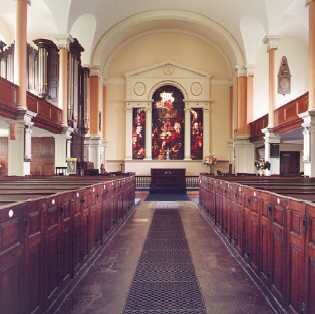
The East Window
The large East Window is most unusual, and is Francis Eginton's best and most renowned work. It is a copy of Benjamin Wests picture of The Conversion of St Paul, painted on glass. The original panting is hung in the Dallas Museum of Art although a further copy is in Smiths College, Massachusetts. Benjamin West was once court painter of historical subjects to King George III.
The Millennium Window
The stained glass window commemorating the Millennium was designed and made by Rachel Thomas who trained as a glazier in the Black Country. The window was a winning entry in the Stevens competition run by The Worshipful Company of Glaziers and Painters of Glass. It was sponsored by the Birmingham Assay Office and incorporates their hall marks for gold, silver and platinum. In the centre of the window is the special asay mark for the Millennium. The angels are pouring molten metal from a crucible; around its rim is the text 'The fear of the Lord is the beginning of wisdom, and to depart from Evil is understanding'. (Job 28)
The Bells
A peal of ten bells was installed in St Paul's Church in 2005.
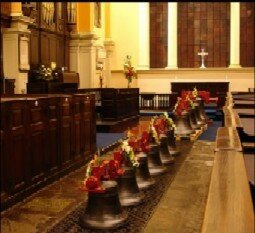
>The Story of the Bells
The Altar
The Christian altar is a table of stone or wood, and is usually beautifully carved. Situated in the centre of the sanctuary, it is the chief focal point with the church. Liturgically the altar faces the east and Jerusalem, the Holy Land of Christs Passion and death. This position is traditional and has scriptural authority in Ezekiel 43.4, And the glory of the Lord came into the house by the way of the gate whose prospect is toward the east. The altar, or holy table, symbolizes the presence of Christ in the sacrament of the Eucharist. Most churches generally have a single altar although some larger churches, such as St Pauls, may have one or more side chapels, each with its own altar.
The Lectern
The word lectern comes from the Latin word meaning 'to read', because the lectern primarily functions as a reading stand. It is typically used by lay people to read the scripture lessons (except for the Gospel lesson in a Eucharistic service), to lead the congregation in prayer, and to make announcements. Lecterns are often in the shape of an eagle, partly because the eagle is the symbol of St. John the Evangelist and partly because it has come to represent the divine inspiration of the gospels more generally.
The Font
The font is the place of baptism. The materials can vary greatly consisting of carved and sculpted marble, wood or metal. The shape can also vary. Many are 8-sided as a reminder of the "new creation" and as a connection to the practice of circumcision which traditionally occurs on the 8th day. Fonts are often placed at or near the entrance to a churchs nave to remind believers of their baptism as they enter the church to worship, since the rite of baptism served as their initiation into the Church. The quantity of water is usually small and is either special holy water or water straight out of the tap. A special silver vessel called an ewer can be used to fill the font.
The Pulpit
A pulpit (from the Latin pulpitum meaning scaffold, platform, or stage) is a small elevated platform where a member of the clergy or an authorised minister stands in order to deliver the sermon.